Toll-Free Scam Numbers and How to Check 800, 833, 844 and 888 Calls
 ·
Published
·
Updated
·
16 min read
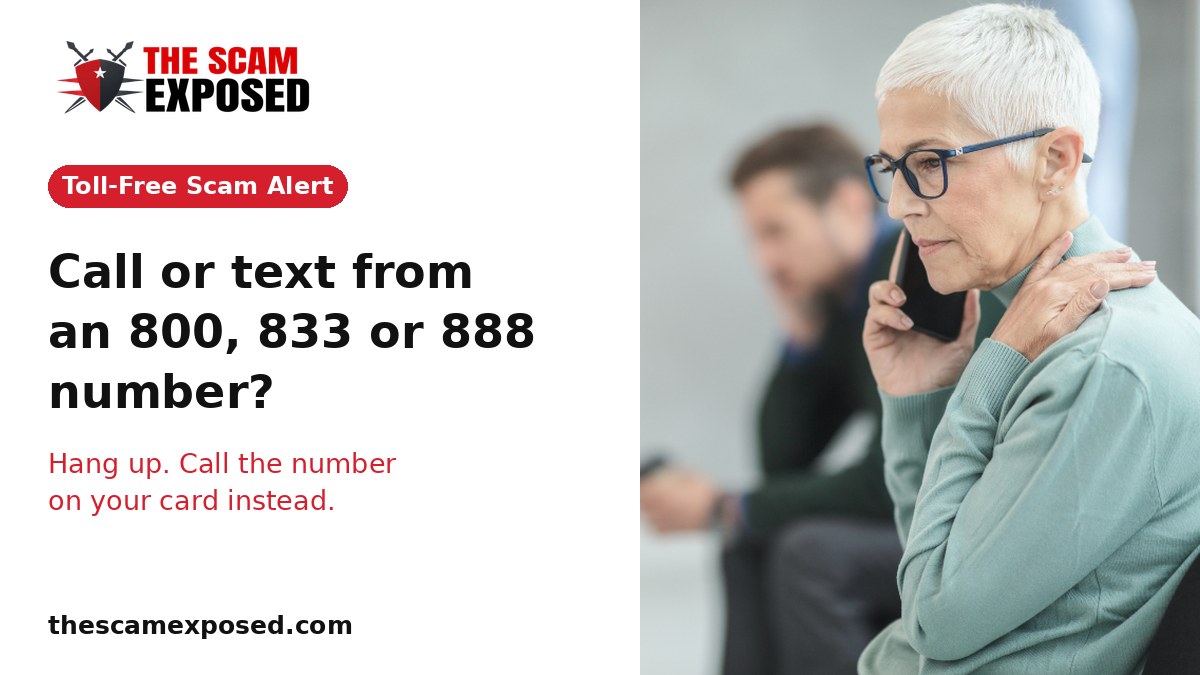
Short answer: Toll-free scam numbers look official, but a call or text from an 800, 833, 844, 855, 866, 877 or 888 number is not proof that a real business is on the line. Scammers rent toll-free numbers and can also fake one on your caller ID. If a toll-free caller says there is a problem with your bank, card, computer, debt or account, hang up and call the company back using the number on your card, statement or the company's own website.
The text says your account is locked and gives you an 833 number to call. A recorded voice offers to lower your credit card rate and asks you to press 1. A pop-up on your laptop flashes a "support" line starting with 888. All three look like they come from a real company, because toll-free numbers have looked official for decades. That trust is exactly what these scams borrow.
At The Scam Exposed, toll-free numbers come up again and again in the reports readers send us and in the public complaint records we review. This guide explains how toll-free numbers work, why scammers like them, which scripts they use, how to check a number safely and what to do if you already called back or paid.
Key takeaways
- The US toll-free codes are 800, 888, 877, 866, 855, 844 and 833, according to the FCC. A toll-free code tells you nothing about who is calling.
- Reducing debt was the top topic in Do Not Call complaints in fiscal year 2025, followed by imposters, in the FTC's report to Congress.
- The FCC says debt relief and loan assistance calls made up 27% of its robocall scam complaints in 2025, the largest single category (FCC, March 2026).
- In the reports we track, 833 is the most reported toll-free prefix, followed by 877, 888, 855, 866 and 844.
- The safest rule: never call back a toll-free number you got from a call, text, email, pop-up or ad. Find the number yourself.
On the phone with a toll-free caller right now? Hang up. Do not press any key, read out a code or install anything. Call your bank or the company using the number on your card or statement. If you already paid or gave access to your computer, go to the step-by-step section on what to do now.
In this article (14)
- How toll-free numbers work
- The seven toll-free prefixes
- Why scammers use toll-free numbers
- What the official data shows
- What we see in the reports we track
- The most common toll-free scam scripts
- Toll-free numbers in scam texts
- Fake support numbers in search results
- Red flags checklist
- How to check a toll-free number safely
- Already called back or paid? Do this now
- How to get fewer toll-free scam calls
- Helping an older parent
- Frequently asked questions
Got a call or text from a toll-free number you don't recognize? Check the number for free against public FTC complaint records before you call back.
How toll-free numbers work
A toll-free number lets people reach a business without paying a long-distance charge. The FCC explains that calls from landlines cost the caller nothing, while mobile callers may use plan minutes unless they have unlimited calling.
Businesses do not get these numbers from the FCC directly. They reserve them through companies called Responsible Organizations, or RespOrgs, and a company called Somos runs the national toll-free database. The FCC says most numbers are handed out first come, first served, and that it is not involved in the actual assignment of each number.
Toll-free numbers can also receive texts if they are "text enabled," and businesses can text back. That is why you may now get texts, not just calls, from numbers that start with 8.
The important point for you: a toll-free number is a routing service, not a background check. It tells you nothing about whether the person using it is honest.
The seven toll-free prefixes
The FCC lists seven toll-free codes and notes they are not interchangeable. Dialing 1-800 and 1-888 with the same last seven digits reaches two different numbers. That detail matters because scammers sometimes pick a number that matches a famous company's number in every digit except the prefix.
| Prefix | Opened | What to know |
|---|---|---|
| 800 | 1967 | The original toll-free code, introduced by AT&T (Somos). Still the most familiar. |
| 888 | March 1996 | Second toll-free code (FCC). |
| 877 | April 1998 | Third toll-free code (FCC). |
| 866 | July 2000 | Fourth toll-free code (FCC). |
| 855 | 2010 | Opened as earlier codes neared exhaustion (FCC). |
| 844 | After 855 | Opened for the same reason, before 833. |
| 833 | April 2017 | Newest code, authorized by the FCC in April 2017 (Federal Register). Most reported toll-free prefix in the reports we track. |
According to Somos, the remaining 8XX codes down to 822 were reserved in 1995 for future toll-free use. If a new code such as 822 opens, expect scammers to use it too, because new codes have plenty of unused numbers.
Why scammers use toll-free numbers
- They look like a business. Banks, airlines and retailers have used toll-free numbers for decades, so many people trust them more than a random local number.
- They are easy to rent. Online phone services can set up a toll-free number quickly. When one gets reported and blocked, the caller moves to the next.
- They work for callbacks. Many scams do not call you at all. They send a text, email or pop-up that asks you to call a toll-free number, so you dial the scammer yourself.
- They can be spoofed. With caller ID spoofing, a scammer can display a number they do not own, including a real company's toll-free line. The FCC explains how spoofing works.
Phone companies are required to use caller ID authentication, known as STIR/SHAKEN. The FTC notes this was required by June 30, 2021, with small providers given until June 30, 2023. It helps flag spoofed calls, but it does not stop a scammer who rents a real toll-free number, and it does not cover a number printed in a text or pop-up.
What the official data shows
Government agencies do not publish complaint counts by toll-free prefix, but their data shows which call topics generate the most complaints. Those topics line up closely with the toll-free calls readers describe to us.
- FTC Do Not Call complaints, fiscal year 2025. The FTC received more than 2.6 million Do Not Call complaints in FY 2025, mostly about robocalls (FTC). The top five topics were reducing debt, imposters, medical and prescriptions, energy and utilities, and home improvement and cleaning.
- Complaint rates by state. In the FY 2025 Data Book, released December 11, 2025, Arizona had the highest rate at 1,028 complaints per 100,000 people, followed by Tennessee, Nevada, Illinois and Florida.
- FCC robocall complaints, 2025. The FCC received more than 125,000 unwanted call complaints in 2025. The top robocall scam categories were debt relief and loan assistance (27%), insurance and healthcare (11%), government imposters (7%), credit and credit cards (4%) and Google listing calls (2%).
- Imposter scams, 2025. People reported losing $3.5 billion to imposter scams in 2025, and nearly one in three fraud reports were about imposters (FTC, June 2026). The FTC says some of the costliest start with a fake security alert, often from a bank, and that these scams also reach people through search engine results.
- Older adults and phone calls. FTC data shows people 80 and over lost more money to scams that started with a phone call than through any other contact method (FTC, April 2026).
These figures are complaints and reports, not a count of every scam call. Many people never report, so real numbers are higher. For a wider view, see our 2026 US scam call statistics with sources.
What we see in the reports we track
We compare reader reports with public FTC Do Not Call complaint records. Three patterns stand out for toll-free scam numbers:
- 833 leads. 833 is the most reported toll-free prefix in the reports we track, followed by 877, 888, 855, 866 and 844. Newer codes have more unused numbers, which makes them easy to rent and replace.
- Debt relief dominates. The most heavily reported toll-free numbers are mostly tied to "lower your interest rate" and debt settlement calls, which matches the FTC and FCC topic data above.
- Numbers burn out fast. Many toll-free scam numbers get a burst of complaints and then go quiet, a pattern we describe in our scam call complaints analysis.
Toll-free prefixes are not tied to a region, so they are left out of our list of area codes scam callers use most. If calls show your own area code instead, read why scam calls show your own area code.
The most common toll-free scam scripts
"Lower your credit card interest rate"
A recorded voice says you qualify for a lower rate or a debt "hardship program" and asks you to press 1. The person who answers wants your card number, Social Security number or an upfront fee. Under the FTC's Telemarketing Sales Rule, for-profit companies that sell debt relief services by phone cannot charge a fee before they settle or reduce your credit card or other unsecured debt. See our guide to debt relief scam call numbers for numbers people have reported.
"Suspicious activity on your account"
A call or text claims there is a large charge or a locked account at your bank, Amazon or another company, and gives you a toll-free number to call. The "fraud department" then asks for a one-time code, your login or a transfer to a "safe account." The FCC's advice is to hang up and call the number on your statement or the back of your card (FCC bank impersonation alert). Our guide to fake bank callers who send couriers to your door shows how far this script can go.
Tech support callback numbers
A pop-up warns that your computer is infected and tells you to call a toll-free "support" line. The FTC says real security warnings will never ask you to call a phone number (FTC). Once you call, the "technician" asks for remote access and payment, and sometimes moves on to your bank account. Read more in fake Microsoft support calls and tech support scams that go after your bank account.
Government and agency imposters
Callers claim to be from Social Security, the IRS, the FTC or even the FCC. In August 2026 the FCC warned that people posing as FCC officials were telling consumers their phone number was under investigation, and said FCC staff will never call to say that or demand payment (FCC). See our list of impersonation scam call numbers.
Utility, warranty and prize calls
A "utility" says your power will be cut off today unless you pay. A "final notice" offers to extend your car warranty. A "prize department" says you won but must pay a fee first. All three often use toll-free numbers to look like a real company. If someone threatens a same-day shutoff, read what to do when a caller says your power will be cut off.
Toll-free numbers in scam texts
More and more scams arrive as texts that include a toll-free number instead of a link. Common examples:
- "Your account has been suspended. Call 1-8XX-XXX-XXXX to restore access."
- "A purchase of $499.99 was made on your card. If this wasn't you, call support."
- "Your package could not be delivered. Call to reschedule."
The number is the bait. Do not call it and do not reply. Forward the text to 7726 (SPAM) to report it to your carrier, then delete it. Our guides to common scam texts and the package delivery text scam show more examples.
Fake support numbers in search results
Some people never get a scam call at all. They search for "airline customer service" or "printer support," call the first number they see and reach a scammer. The FTC warns that tech support scammers try to get their websites into search results and run their own ads, hoping you will call the number shown.
Before you call a support number you found online, go to the company's official website by typing the address yourself, or use the number printed on your bill, receipt or product. Our guide to how search ad scams hide from reviewers explains why a polished ad can still be fake.
Red flags checklist
- The call or text came out of the blue, and you did not contact the company first.
- A recorded voice asks you to press 1 or press a key to be removed.
- The caller will not give a full company name, address or website.
- You are told to call a toll-free number from a text, email, pop-up or voicemail.
- They ask for a one-time code, password, PIN or full card number.
- They want remote access to your computer or phone.
- They ask for payment by gift card, wire transfer, payment app, cryptocurrency or cash.
- They want a fee before doing anything, such as reducing your debt or releasing a prize.
- They say it is urgent and tell you not to hang up or not to tell anyone.
One red flag is enough to hang up. A real company will still be there when you call back on a number you trust.
How to check a toll-free number safely
- Do not call it back yet. If the number came from a call, text, email, pop-up or ad, treat it as unverified.
- Find the official number yourself. Use the back of your card, a recent statement, the company's app or a website address you type in.
- Compare all ten digits. Watch for numbers that match a real company except for the prefix, such as 833 instead of 800.
- Look up the number. Search it in our free robocall checker to see whether others have reported it. No reports does not mean safe, because scammers change numbers often.
- Call the company, not the caller. Ask the real company whether the call or text came from them.
| Where the number came from | Risk |
|---|---|
| Printed on your card, statement or bill | Generally safe |
| A website address you typed in yourself | Generally safe |
| Caller ID on an unexpected call | Unverified, may be spoofed |
| A text, email or voicemail you did not expect | High risk |
| A computer pop-up or browser warning | Scam |
| A sponsored search result or social media ad | Verify before calling |
Already called back or paid? Do this now
Act quickly and do not let embarrassment slow you down. These steps follow the FTC's guidance on what to do if you were scammed. Acting fast does not guarantee you will get money back, but it gives you the best chance.
1. Stop contact
Hang up and do not call the number again. Do not answer follow-up calls from the same group.
2. Call your bank or payment company
Use the number on your card or statement. Tell them it was a scam and ask them to stop or reverse the payment. Our step-by-step guides cover each payment method: gift cards, wire transfers, payment apps and cryptocurrency.
3. If you gave remote access
Disconnect the device from the internet, run a security scan or take it to a trusted repair shop, and change your passwords from a different device. Turn on two-step verification for email and banking.
4. If you shared personal information
If you gave your Social Security number or account details, visit IdentityTheft.gov for a recovery plan.
5. Report it
Report the scam to the FTC at ReportFraud.ftc.gov and unwanted calls at DoNotCall.gov. You can also file a complaint with the FCC. If money was lost online, the FBI accepts reports at IC3.gov. You can also report the number to The Scam Exposed so the next person sees a warning.
6. Watch out for "recovery" calls
People who lost money are often contacted again by someone promising to get it back for a fee. That is a second scam. Read why past victims are targeted again, and see our full checklist on what to do right after a scam.
How to get fewer toll-free scam calls
- Turn on your carrier's free spam filter. Our comparison of free scam call blocking on AT&T, Verizon and T-Mobile shows where to find it.
- Silence unknown callers. Set up the five phone settings that stop most scam calls.
- Never press a key to be removed. It only confirms your number is active. Just hang up.
- Register your number. Add it to the National Do Not Call Registry at DoNotCall.gov. Legal telemarketers must honor it, and complaints help regulators track illegal callers.
- Report the numbers. Each report adds to the public data that call-blocking services use.
Helping an older parent
If a parent or grandparent gets a lot of these calls, a few small changes help more than a long warning.
- Set up call filtering together. Turn on the carrier filter and silence unknown callers. It takes a few minutes.
- Save real numbers in their contacts. Add the bank, card company, pharmacy, doctor and family, so real calls show a name.
- Write one rule next to the phone. "If a company calls me, I hang up and call the number on my card."
- Agree to talk before paying. Ask them to call you before sending money, buying gift cards or giving anyone access to a computer.
Our tech support scam guide for seniors, the grandparent scam guide and our overview of the costliest scams targeting older adults are good to share with family.
Frequently asked questions
Are 833, 844 and 888 numbers real toll-free numbers?
Yes. The FCC lists 800, 888, 877, 866, 855, 844 and 833 as US toll-free codes. A real toll-free code does not mean the caller is a real business.
Why do scammers use 833 numbers so much?
833 is the newest toll-free code, so it has many unused numbers that are easy to rent and replace. In the reports we track, 833 is the most reported toll-free prefix.
Can a scammer show a real company's toll-free number on caller ID?
Yes. Caller ID spoofing can display almost any number, including a real bank's customer service line. Hang up and call back using a number you find yourself.
Should I call back a missed call from a toll-free number?
Only if you recognize the company and you use the number from your card, bill or the official website, not the number that called you.
Does it cost money to call a toll-free scam number?
Usually not. The FCC says landline callers pay nothing, and mobile callers may use plan minutes. The danger is what the person on the line asks you to do, such as share codes, pay or install software.
How do I report a toll-free scam number?
Report it to the FTC at ReportFraud.ftc.gov, file unwanted call complaints at DoNotCall.gov, and forward scam texts to 7726. You can also report it to The Scam Exposed so others see a warning.
Next step: Search another number or report a number that called you.
How we wrote this: Figures come from FTC and FCC publications linked next to each claim, and each is labeled with the period it covers. Government agencies do not publish complaint counts by toll-free prefix, so prefix rankings come from the reports we track and are not official statistics. Text examples are illustrative. See our editorial policy for how we review sources. The Scam Exposed is an independent educational platform. We are not a government agency, law enforcement body, or legal advisors. Consult official channels for legal recourse.
Read next on this topic
 PayPal Invoice Scam? How to Spot a Fake Invoice and What to DoRead guide →
 Text Says Your Package Cannot Be Delivered? Do This FirstRead guide →
 Caller Says Your Power Will Be Cut Off? Do This FirstRead guide →
 Check a Charity Before You Give This Giving SeasonRead guide →
 Why Scam Calls Show Your Own Area Code (and How to Stop Them)Read guide →
 2026 US Scam Call Statistics, Real Numbers With SourcesRead guide →
Share Your Experience
No one has commented yet. If this happened to you as well, say so below. Knowing that other people had the same call makes it far easier for the next person to trust their instincts.
Add Your Comment
Every comment is read by a person before it appears, so it will not show up straight away. Never post your phone number, address, or bank details here.