
Is That Really Social Security Calling? How to Spot Impersonation Scam Calls
 ·
Published
·
Updated
·
18 min read
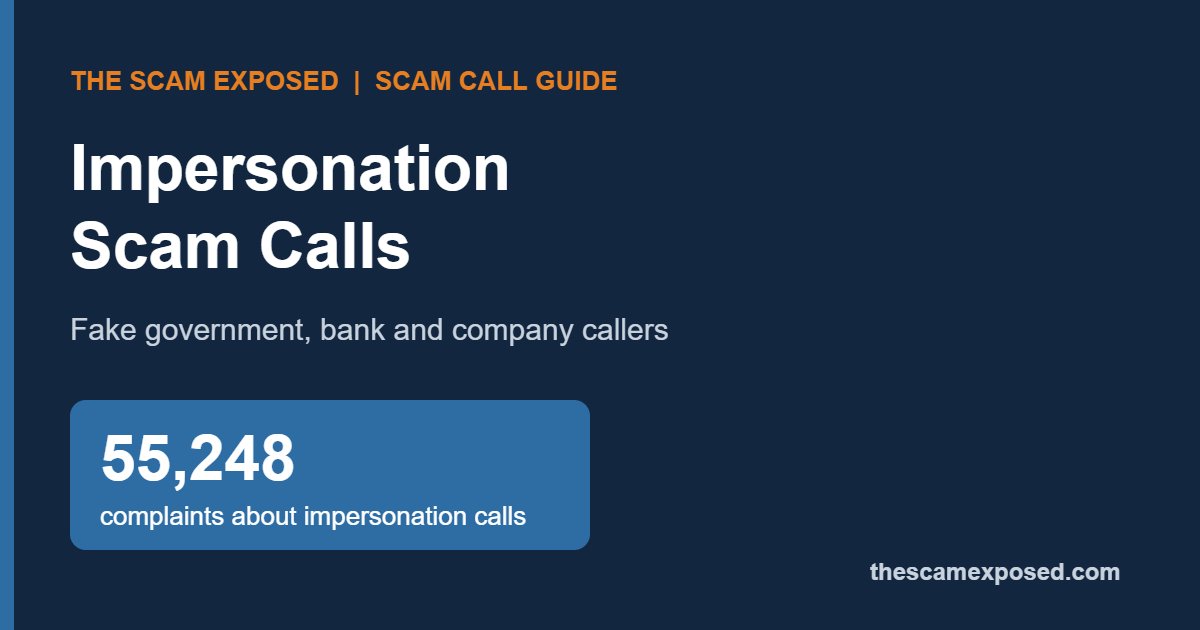
If a caller says they are from Social Security, the IRS, your bank, Amazon or the sheriff's office, and they want money or personal details right now, it is almost certainly a scam. Hang up and call the organization back on a number you find yourself.
That one rule stops most impersonation calls. The hard part is remembering it when a calm, official sounding voice tells you your Social Security number is linked to a crime, or that your grandson is in jail, or that someone just tried to drain your bank account. These calls are built to make you panic first and think later.
At The Scam Exposed, we track and analyze scam call reports from our readers alongside public FTC complaint data. Impersonation is one of the biggest categories we see every month. This guide explains how these calls work, what the latest official numbers show, the exact scripts callers use, and what to do if you or someone you love already answered one.
Data note: Figures in this article come from our snapshot of public FTC Do Not Call complaint data taken in August 2026. Our database keeps updating as new complaints come in, so newer pages or tools on this site may show different totals.
Key takeaways
- People reported losing $3.5 billion to imposter scams in 2025, according to the FTC. That includes about $920 million to government impersonators and nearly $1 billion to business impersonators, led by fake bank callers.
- In August 2026, about 1 in 5 scam call complaints in the FTC Do Not Call data we analyze were about impersonation.
- Social Security says its employees will never suspend your Social Security number, threaten arrest or ask for gift cards, according to SSA.
- Caller ID can be faked. A real agency name on your screen proves nothing.
- No government agency will ask you to pay with gift cards, cryptocurrency, a wire transfer or a payment app, or to move money to "protect it."
In this article (13)
- What is an impersonation scam call?
- Already paid or shared details? Start here
- How big the problem is right now
- States where impersonation calls lead
- Who the callers pretend to be
- How the call usually goes, step by step
- A real case from October 2026
- Why these calls feel so real
- Red flags
- Real agency vs scam caller
- How to protect yourself and your parents
- Frequently asked questions
- How we researched this article
What is an impersonation scam call?
An impersonation scam call is a phone call where the caller pretends to be someone you trust, such as a government agency, your bank, a well known company, the police or a family member, so you will send money or share personal information. The FTC calls these "imposter scams," and they have been the most reported type of fraud in its data for five years in a row.
The caller usually invents an urgent problem. Your Social Security number has been "suspended." There is a warrant for your arrest. Someone is using your Amazon account. Your bank account has been hacked. Then they offer the solution, which always involves you paying, reading out a code, or moving your money somewhere "safe."
Some calls start as a recorded message that asks you to press 1. Others come from a live person who already knows your name and address. Many start with a text, email or a pop-up on your computer that tells you to call a number. The phone is where the real pressure happens.
Got a call or text like this? Check the number for free against public FTC complaint records before you call back or reply.
Already paid or shared details? Start here
If you sent money or shared information in the last few days, act now. Speed matters more than anything else. Work through these steps in order, and do not wait until you are sure it was a scam.
- Call your bank or card company using the number on the back of your card. Ask them to stop or reverse the payment and to flag your account.
- If you paid with a gift card, call the company that issued the card using the number on the back and ask them to freeze the balance. Keep the card and the receipt.
- If you sent cryptocurrency or used a Bitcoin ATM, contact the exchange or ATM operator right away and report it to the FBI Internet Crime Complaint Center.
- If you shared your Social Security number, place a free credit freeze with Equifax, Experian and TransUnion, then follow the recovery plan at IdentityTheft.gov.
- If you gave someone remote access to your computer, disconnect it from the internet, then change your passwords from a different device.
- Report the call at ReportFraud.ftc.gov.
- If you are 60 or older, or helping someone who is, call the National Elder Fraud Hotline at 1-833-372-8311. It is free and run by the U.S. Department of Justice, Monday to Friday, 10:00 a.m. to 6:00 p.m. Eastern.
Our full guide on what to do in the first 48 hours after a scam walks through each payment type in more detail.
How big is the problem right now?
Impersonation is one of the most expensive scams in the United States, and the losses keep growing. Here are the latest official figures, with the year each one covers.
| Figure | Period | Source |
|---|---|---|
| $3.5 billion reported lost to imposter scams | 2025 | FTC, June 2026 |
| About $920 million lost to government impersonators (up from $789 million in 2024) | 2025 | FTC, June 2026 |
| Nearly $1 billion lost to business impersonators, with bank impersonators causing the highest losses | 2025 | FTC, June 2026 |
| 32,400 government impersonation complaints, about $798 million in losses | 2025 | FBI IC3, May 2026 |
| More than 8,600 government impersonation complaints from people over 60 | 2025 | FBI IC3, May 2026 |
| Losses over $100,000 to impersonators among adults 60+ rose from $55 million to $445 million | 2020 to 2024 | FTC, August 2025 |
| About 19% of scam call complaints were about impersonation | August 2026 | Our analysis of FTC Do Not Call complaint data |
Two things stand out. First, the money lost to government impersonators went up by more than $130 million in a single year. Second, older adults are not just targeted more often, they lose far more per case. The FTC found that the eight-fold rise in six figure losses among people 60 and over came mostly from callers posing as government agencies or businesses who talked people into moving their savings.
The FBI's figures for older adults are just as stark. People over 60 filed more than 201,000 complaints with IC3 in 2025 and reported losses of more than $7.7 billion, a 59% increase in losses from 2024, according to the FBI. That figure covers all internet crime, not only impersonation, but impersonation calls are one of the main ways these cases begin.
Keep in mind that these are only the cases people report. Many victims never file a complaint, often out of embarrassment, so the real numbers are higher.
For every scam call type, not only impersonation, see our analysis of unwanted and scam call complaints.
In which states do impersonation calls lead?
In August 2026, impersonation was the most reported scam call topic in Texas, Pennsylvania, Washington, Missouri, Alabama, South Carolina, Oregon, West Virginia, New Hampshire and North Dakota, based on our analysis of FTC Do Not Call complaints by the state of the person reporting. In most other states, debt relief calls came first and impersonation came second or third.
Here are the states with the most impersonation complaints that month.
| State | Share of all scam call complaints in the state |
|---|---|
| California | 22.5% |
| Florida | 18.8% |
| Texas | 18.8% |
| Illinois | 18.1% |
| Virginia | 21.9% |
| Pennsylvania | 21.2% |
| Tennessee | 18.2% |
| New York | 20.7% |
| Georgia | 15.6% |
| Massachusetts | 25.8% |
Big states top the list because more people live there, so the share column is the fairer comparison. In Massachusetts, more than one in four scam call complaints in August were about impersonation. A low number in a state does not mean the state is safe. It can simply mean fewer people reported their calls.
You can see every state, including the numbers calling each one most, on our US scam call map.
Who do impersonation scammers pretend to be?
Scammers copy whoever you are most likely to trust or fear. These are the six versions we see most in complaints, along with what the real organization actually says.
Social Security Administration
The caller says your Social Security number has been suspended, or that it was used in drug trafficking or money laundering. They say your benefits will stop unless you "verify" your number or move your money. Social Security says its employees will never suspend your Social Security number, threaten you with arrest or legal action, demand immediate payment, or ask for payment by gift card, prepaid debit card, wire transfer or cash, according to SSA. More detail is in our guides to Social Security scams in 2026 and fake SSA audit calls.
The IRS
The caller says you owe back taxes and a warrant will be issued unless you pay today, usually with gift cards or a wire transfer. The IRS says it normally contacts you the first time by mail delivered by the U.S. Postal Service, and that a call which is unexpected, rushes you, threatens you or demands payment now is a warning sign, according to the IRS.
Medicare
The caller offers a new Medicare card, a free genetic test, a back brace or a "better plan," then asks for your Medicare number. These calls jump during Open Enrollment, which runs from October 15 to December 7. Medicare says it will never call you to sell you anything or visit you at your home, according to Medicare.gov. Our guide to Medicare calls hitting seniors this fall covers the current scripts.
Your bank's fraud department
This is now the costliest business impersonation, according to the FTC. The caller says there is fraud on your account and asks you to read out the one-time code your bank just texted you, move money to a "safe account," or hand your debit card to a courier. Your bank will never send someone to your home to collect your card. See how fake bank callers send couriers to your door.
Amazon, Apple, Microsoft and other big companies
The call or pop-up says someone bought an expensive item on your account, or that your computer has been hacked. The caller then asks for remote access to your computer or tells you to buy gift cards to "reverse" a charge. Tech companies do not call people out of the blue to fix their computers. Our guide to tech support scams for seniors shows what to do.
Police, sheriff's deputies, courts and federal agents
The caller says you missed jury duty, have a warrant, or that a relative has been arrested and needs bail. Some even claim to be from the FTC, the agency that fights scams, and send a photo of a badge. The FTC says a real FTC employee will not text you a photo of their ID to verify who they are, according to its June 2026 consumer alert. No law enforcement agency collects fines or bail over the phone.
Getting a call about missed jury duty? See how the fake warrant call works.
How does an impersonation scam call usually go?
The names change, but the structure of the call barely does. The FTC describes the same pattern in its 2025 analysis of six figure losses. Knowing the steps makes the call much easier to recognize while it is happening.
Step 1: The hook
A call, text or pop-up appears with an urgent problem. "Suspicious activity on your account." "Your Social Security number has been suspended." "Your computer is infected, call this number."
Step 2: Proof that is not proof
The caller reads out your name, address or the last four digits of your Social Security number. Caller ID shows a real agency or bank. They give you a badge number or a case number. All of this is easy to fake or buy from old data breaches.
Step 3: Fear
Now the threat arrives. Your account will be frozen. You will be arrested today. Your savings will be gone by tonight. Fear shuts down careful thinking, which is exactly the point.
Step 4: Isolation
You are told to stay on the line, not to hang up, and not to tell anyone, including your bank teller or your family, because "they might be involved." Sometimes a second caller "transfers in" as a supervisor, officer or lawyer.
Step 5: The payment
You are told to buy gift cards, withdraw cash, put money into a Bitcoin ATM, wire money, or hand cash or gold to a courier. Often it is framed as protecting your money rather than paying a fine. The FTC is clear that no one legitimate will ever tell you to move your money to protect it.
A real case: the deputy impersonation wave in Georgia
In mid October 2026, the Houston County Sheriff's Office in Georgia said it was receiving 20 to 30 calls a day from residents targeted by scammers posing as deputies or supervisors, sometimes using the names of real staff, according to 41NBC. The callers threatened arrest over invented warrants, kept people on the line, and pushed them to pay by credit card or at a cryptocurrency kiosk.
The same month, the Lamoille County Sheriff's Department in Vermont warned that callers using blocked numbers were posing as officers and telling people a relative was in custody and needed money for release, according to Newport Dispatch.
Look at what these two cases share. A trusted authority. A real sounding name. A threat involving jail. A demand to pay right now in a way that is very hard to undo. Every one of those is a red flag on its own. Together, they are a script.
This matches what Georgians report in the federal data. In August 2026, about 16% of Georgia's scam call complaints were about impersonation, according to our analysis of FTC Do Not Call data on our Georgia page.
Why do these calls feel so real?
The caller ID looks official. Scammers can make any name or number appear on your screen. The FCC explains that caller ID spoofing lets callers deliberately falsify the information shown, which is why caller ID should never be treated as proof, according to the FCC.
They already know things about you. Names, addresses, birth dates and partial Social Security numbers have leaked in years of data breaches and are sold online. Knowing your details does not make someone legitimate.
They use authority and fear. Most of us are taught to cooperate with police and government officials. Scammers use that instinct against us.
They cut you off from help. The instruction to stay on the line and tell no one is the single most reliable sign of a scam, because it removes the person who might say "wait, this sounds wrong."
AI makes voices more convincing. Some callers now use AI to copy the voice of a grandchild or a relative from short clips posted online. Our guide on protecting your family from an AI voice grandparent scam explains how a family safe word stops this.
Red flags of an impersonation scam call
- Your number is "suspended." Social Security does not suspend numbers.
- A threat of arrest, a lawsuit or losing benefits. Real agencies do not threaten you over the phone.
- Payment by gift card, crypto, wire, payment app or courier. No government agency accepts these.
- "Move your money to keep it safe." This is always a scam, no matter who says it.
- "Stay on the line" or "don't tell anyone." A real agency will be fine if you hang up and call back.
- A request for a one-time code. That code is the key to your account. Never read it out to a caller.
- A pop-up telling you to call a number. Real companies do not lock your computer and ask you to phone them.
- A badge or ID photo sent by text. Anyone can make a fake one in minutes.
The one rule to remember: if someone calls claiming to be a government agency, your bank or a big company, hang up and call back using a number you find yourself, such as the one on your card, a statement or the official website. A real agency will still be there when you call back. A scammer will not.
Real agency vs scam caller
| Situation | The real organization | A scam caller |
|---|---|---|
| First contact | Usually a letter by mail (IRS, SSA) | A surprise call, text or pop-up |
| Tone | Calm, gives you time | Urgent, threatening, "today only" |
| Payment | Official channels, never gift cards or crypto | Gift cards, crypto, wire, payment apps, cash couriers |
| Your money | Never asks you to move it to protect it | "Transfer it to a safe account" |
| Hanging up | Fine, you can call back | "Do not hang up or you will be arrested" |
| Verification codes | Never asks you to read them out | "Read me the code we just sent" |
| Secrecy | Encourages you to ask family or your bank | "Do not tell anyone, not even your bank" |
How to protect yourself and your parents
- Agree on the call back rule now. Talk about it before a call comes. Many families write "Hang up and call back" on a card next to the phone.
- Keep the real numbers handy. Write down the numbers for the bank, Social Security (1-800-772-1213), Medicare (1-800-633-4227) and the doctor's office.
- Set a family safe word. If someone calls claiming to be a grandchild in trouble, the caller must know the word.
- Turn on call filtering. Our guides to five phone settings that stop most scam calls and free carrier blocking from AT&T, Verizon and T-Mobile take a few minutes to set up.
- Do not press buttons on robocalls. The FTC warns that pressing a key can lead to more calls.
- Check the number. Look up any number that called you on our robocall checker to see if others have reported it.
- Make it safe to ask. Tell your parents they will never be judged for calling you to check. Scammers rely on embarrassment and secrecy.
- Print a reminder. Our free printable scam safety card fits next to the phone.
Watch out for the second scam. After people lose money, they are often called again by someone posing as a government recovery agent, a lawyer or even the FTC, offering to get the money back for a fee. Real agencies do not charge to recover your money. Read why past scam victims are targeted again.
Another call that borrows an agency name to scare you into paying: the utility shut-off scam.
Frequently asked questions
Can Social Security really suspend my Social Security number?
No. Social Security says its employees will never suspend your Social Security number. A call saying yours has been suspended is a scam. Hang up and call Social Security at 1-800-772-1213 if you are worried.
The caller ID showed a real government number. Could it still be fake?
Yes. Caller ID spoofing lets scammers show any name or number on your screen, including a real agency's number. Hang up and call the agency back using a number you look up yourself.
How did the caller know my address and part of my Social Security number?
Personal details are often exposed in data breaches and sold online. A caller knowing your information does not make them legitimate.
Will the police or a federal agent call me to ask for payment?
No. Law enforcement does not call to collect fines, bail or warrant fees over the phone, and never asks for gift cards or cryptocurrency.
Does the IRS ever call first?
The IRS says it normally contacts you the first time by mail. An unexpected call that rushes you, threatens you or demands payment now is a warning sign.
My bank called about fraud and asked for a code. What should I do?
Do not read out the code. Hang up and call the number on the back of your card. Your bank will never ask you to share a one-time code or move money to a safe account.
Should I call back a number that left a voicemail?
Not the number in the voicemail. If you think the message could be real, look up the organization's official number yourself and call that instead.
Where do I report an impersonation scam call?
Report it at ReportFraud.ftc.gov. If you lost money online or by crypto, also report to the FBI at ic3.gov. People 60 and over can get free help from the National Elder Fraud Hotline at 1-833-372-8311.
How we researched this article
The national loss figures come from the FTC's June 2026 release on 2025 fraud reports, the FTC's August 2025 analysis of impersonation losses among older adults, and the FBI Internet Crime Complaint Center's 2025 findings published in May 2026. The rules about what agencies will and will not do come directly from SSA, the IRS, Medicare.gov, the FCC and FTC consumer guidance. The state figures are our own analysis of the FTC's public Do Not Call complaint data for August 2026, counted by the state of the person reporting. Monthly state figures are estimates where a number was reported from more than one state. The two real cases come from local news reports published in October 2026.
The Scam Exposed is an independent educational platform. We are not a government agency, law enforcement body, or legal advisors. Consult official channels for legal recourse. Complaint data shows what people reported and does not prove that any specific number or caller committed a crime.
Read next on this topic
 PayPal Invoice Scam? How to Spot a Fake Invoice and What to DoRead guide →
 Text Says Your Package Cannot Be Delivered? Do This FirstRead guide →
 Caller Says Your Power Will Be Cut Off? Do This FirstRead guide →
 Check a Charity Before You Give This Giving SeasonRead guide →
 Why Scam Calls Show Your Own Area Code (and How to Stop Them)Read guide →
 2026 US Scam Call Statistics, Real Numbers With SourcesRead guide →
Share Your Experience
No one has commented yet. If this happened to you as well, say so below. Knowing that other people had the same call makes it far easier for the next person to trust their instincts.
Add Your Comment
Every comment is read by a person before it appears, so it will not show up straight away. Never post your phone number, address, or bank details here.