
Real Grandparent Scam Cases and the Second Call Trap
 ·
Published
·
13 min read
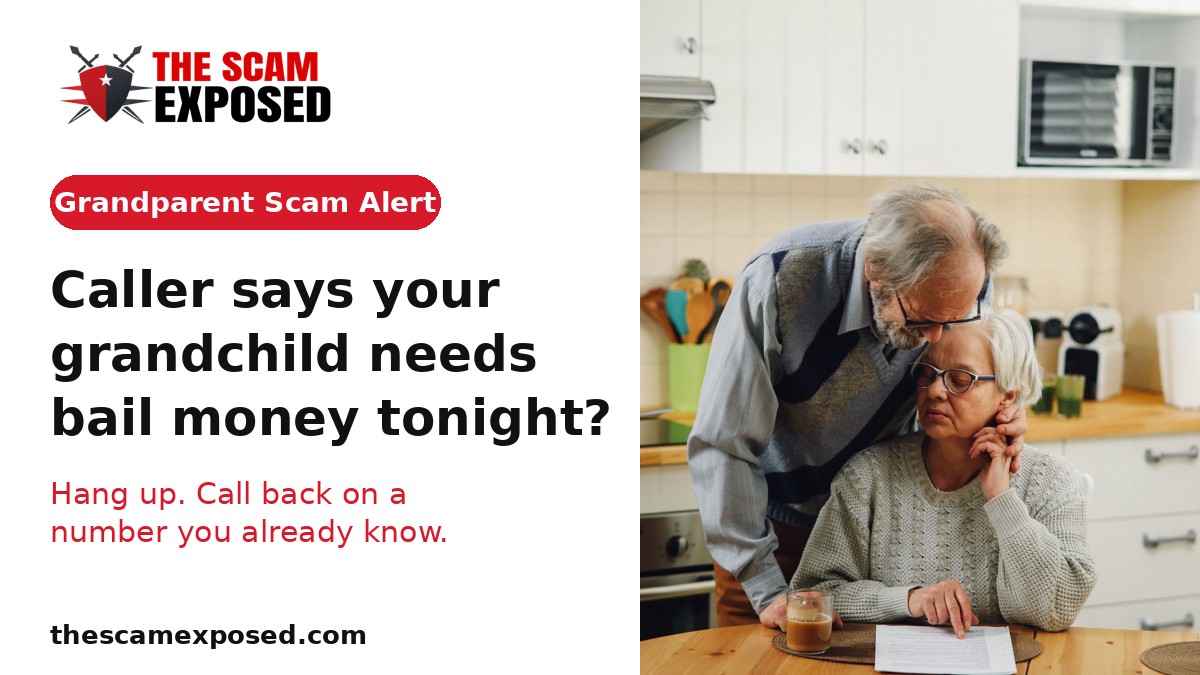
Short answer: In a grandparent scam, a caller pretends to be a grandchild in trouble, or a lawyer or officer speaking for them, and says money is needed tonight for bail, a crash or a hospital bill. Court records and police reports show the same pattern again and again: one payment, then a second, bigger demand within a day or two. Hang up, call your grandchild or their parents on a number you already have, and never pay by wire, gift card, crypto, payment app, or cash handed to a courier.
The call is built to end with someone at your front door holding out an envelope. We read police reports, federal court filings and family accounts to see what actually happens in these cases, where victims lost money, and the moments when it was stopped. Most of those moments were small and ordinary.
Key takeaways
- The second call is the pattern. In four of the cases below the caller came back for more money within one to two days. That second demand is when most families figure it out, and when police were able to catch couriers.
- It is a business, not a lone caller. A 2024 federal indictment describes call-center staff who open the call, others who close it, and dispatchers who send local couriers to victims’ homes.
- Your family’s details are often public. Police, the BBB and prosecutors say scammers read social media for names, pets and travel plans.
- Cloned voices are real, and the FTC’s November 18, 2026 alert says a face on video can be faked too. Verify through another phone number, not by how the voice sounds.
- Speed matters after payment. In one New York case the money was recovered because it was still in the account the same day.
On the phone with a “grandchild” right now? Hang up. Call your grandchild or their parents at a number you already have. If you already sent money, go to what to do after paying.
In this article (10)
Real cases at a glance
These come from police reports, prosecutors and news coverage. Names of victims are left out.
| Case | The story told | Money | How it ended |
|---|---|---|---|
| Warwick, Rhode Island | Grandchild needs bail, then is “being sued” | $18,000 paid, then $40,000 demanded | Grandparents called police after the second demand. Two couriers were arrested. |
| St. Clair County, Michigan | Grandson arrested, needs bond | $8,500 paid, then $12,000 more asked | The victim and her daughter called police. The courier was arrested and the cash found. |
| Pine Township, Pennsylvania | Grandson in a serious crash; caller played both grandson and attorney | $9,500 paid, then $7,500 asked | She realized after the second ask. The callback number was out of service. |
| San Rafael, California | Grandson arrested in Florida, then a “police officer” calls about attorney fees | $21,000 then $29,000 wired | $50,000 lost. She reported it only after the calls stopped. |
| Reading, Pennsylvania (2021) | Texting driver hit a pregnant woman, then “manslaughter charge” the next day | $6,800 asked, $5,000 withdrawn, not sent | The grandfather doubted the voice and called the parents before sending. |
| Winter Park, Florida | Granddaughter in a crash, needs bail | $16,000 in cash | Learned hours later when they spoke to her. Money not recovered. |
| Nassau County, New York | 86-year-old told her grandson was held abroad | Nearly $10,000 wired | The district attorney got a court order and recovered it the same day. |
Got a call or text like this? Check the number for free against public FTC complaint records before you call back or reply.
The second call
Look at the table again. In Rhode Island, Michigan, Pennsylvania and California, the caller came back for more. The stories get bigger: bail turns into a lawsuit, a bond into “complications with the court,” an arrest into attorney fees. In the Reading case the next-day twist was that the pregnant woman had died and the charge was now manslaughter.
Two things follow. First, a second demand is the strongest sign you have that the first one was a scam, so it is the point to stop and call someone. Second, it is a chance for police. In Rhode Island and Michigan, officers waited at the home for the courier’s return and made arrests. If you realize it was a scam after paying, call police before you hang up on the caller or block the number, and ask them what to do if the caller phones again.
Do not play detective alone. A Long Island grandmother who is a former 911 dispatcher kept a caller talking and then had police waiting at her door when the “lawyer” arrived. That worked because she called police first. Do not meet or confront a courier yourself.
Who is behind the call
A federal case announced in New Jersey in April 2024 described the scam as a division of labor. “Openers” make the first call and play the grandchild. “Closers” take over as a lawyer or other official and pressure the victim for cash. “Dispatchers” then send U.S.-based couriers to the victim’s home, and in some cases victims were told to mail cash. Prosecutors said the call centers were outside the United States and the couriers brought the money to other members of the group. You can read the press conference summary from the U.S. Attorney’s Office.
That structure explains the pattern in the cases above. The person who comes to your door often is not the caller and may not know much about the scam. In the Michigan case, the man arrested told troopers he had been sent to collect the money. Couriers are usually a local layer, and the people running the calls are somewhere else.
How they know your family
Several sources say the same thing. The Better Business Bureau serving northwest Ohio and southeast Michigan said scammers search Facebook, Snapchat, YouTube and Instagram for grandchildren’s pages, then learn the names of siblings, pets and recent trips. A San Francisco district attorney’s office representative made a similar point in a CBS report. The FTC adds that scammers use information they find on social media, like where you and your loved one live.
The details are not always accurate, but they only have to be close. A Long Island grandmother told CBS she suspected the caller had learned about her grandson from his Facebook page. In another account, a woman said the caller said “broken nose” to explain why his voice sounded off. Many callers do not know the grandchild’s name at all. They say “It’s me” and wait for you to say it.
Voice cloning: what it changes
The FTC says some scammers use digital tools to clone a loved one’s voice or create fake video. A retired CIA officer demonstrating voice cloning for CBC said only a few seconds of audio is needed. A Canadian woman who nearly paid in 2021 told CBC the voice sounded slightly different, but the call convinced her anyway. Her family suspects cloning but cannot prove it.
In 2025 the FBI’s Internet Crime Complaint Center began counting AI-related complaints separately. It logged more than 22,000, with $893 million in losses, of which older adults accounted for $352 million. These numbers cover all AI-related scams, not only grandparent scams, and the FBI notes they are based on what victims report. We did not find an official total for grandparent scams alone.
What does not change is the structure. The call still has an emergency, secrecy, a deadline and a payment that cannot be reversed. A cloned voice only removes the old clue (“it doesn’t sound like him”). The check that still works is calling back on a number you already have. More in our guide to AI voice clone scams.
Six moments when it was stopped
- A store clerk. A British Columbia woman sent money at a Safeway money-transfer counter and mentioned it was for her grandson in jail. The clerk told her it was a scam and stopped the transfer, and she got her money back.
- A money-transfer company. A Denver grandmother wired $4,600 for a “grandson” in a Bolivian jail. When the caller asked her to re-send it to Spain, Western Union persuaded her to call her grandson, who answered in Boulder.
- A daughter. In Michigan, the victim and her daughter contacted authorities together after the second call.
- The parents. The Reading grandfather questioned the voice, withdrew cash, and still called his grandson’s parents before handing it over.
- The police station. A Kelowna, B.C., couple went to the RCMP detachment with $1,000 to post bail. An officer quickly found their grandson was not in custody, and they lost nothing.
- A question about the arrest. A Winter Park police chief tells families to ask which agency made the arrest, then call that agency yourself.
None of these needed technical skill. Each was another person or one extra phone call. When you go to a bank or store to send money, tell the staff exactly why. They have seen this before.
Accounts from families
The accounts in this section are first-person stories from newsletters and comment threads. We could not verify them, so we treat them as examples of what families report, not as proof.
- “Grandma Kay,” 91. A writer recounts that a caller posing as him said he had been in a car accident in Barcelona and needed money wired for surgery, and not to tell his mother. His grandmother said it did not sound like him. The caller said his nose was broken. She did not send money, and the family reported it to Western Union’s fraud department. Source: newsletter post.
- The postcard. A commenter wrote that after sending his grandmother a postcard addressed “Grandma,” someone phoned her pretending to be him. He believes the postcard was how they got her number, but that is his guess. A relative who became suspicious called his cell and found him at his desk. Source: comment thread.
- Two tests from FTC comment threads. One reader said she noticed a recording of her “granddaughter” used words and phrases the real girl never would. Another said she asked a caller when he last spoke to “grandma,” and he said two weeks ago, although that grandmother had died years earlier. Source: FTC comments.
The common thread is a small detail that did not fit, plus a person who had a way to check.
What to say on the call
You do not need to be polite or to argue. These lines work because they end the call without asking you to judge the voice.
- “Who is this?” Do not say a name first.
- “I’ll call you right back.” Then hang up and call your grandchild or their parent on a number you already have.
- “Which police department arrested you?” Then look up that department’s number yourself.
- “I’m going to ask my son/daughter.” A real emergency survives a two-minute check. A scam does not.
If a “lawyer” says you must keep it secret, or says a gag order stops you from telling family, hang up. No court bars a grandparent from calling the grandchild’s parents.
A family safe word
The FBI recommends a secret word or phrase that family members can use to verify one another, in its December 2024 warning. Pick something that is not on social media, tell everyone in person, and give the rule: if someone calls asking for emergency money, ask them for the word. Do not say it yourself. A UC Berkeley professor who studies deepfakes has said that he and his wife use one.
It will not help if you forget it in a panic. Put the rule on paper near the phone, together with a list of your grandchildren’s and their parents’ numbers.
Already paid? Do this now
Time decides how much can be done. The Nassau County recovery happened because the money was still in the account the same day. These steps follow the FTC’s guidance on what to do if you were scammed. Nothing here guarantees a refund.
- Call the company you paid through, first. Bank for wires and transfers. The issuer for gift cards (guide). The app for payment apps (guide). The ATM operator for crypto (guide). See also wire transfers.
- If cash went to a courier or was mailed, call local police right away and tell them the caller may phone again. Police have used that second call to make arrests. See the cash guide.
- Tell your family so the same group does not target a relative next.
- Report it at ReportFraud.ftc.gov and IC3.gov. If you are 60 or older, the National Elder Fraud Hotline is 1-833-372-8311.
- Ignore “recovery” offers. People who promise to get your money back for a fee are a second scam. See this guide.
For adult children: tell your parents it is fine to hang up on you, and that you would rather get a call about a scam than hear about it afterwards. Embarrassment keeps many families from reporting, which is one reason official numbers are low. More in our elder safety guides.
FAQ
Why does the caller ask for more money after the first payment?
Because the first payment shows the victim will pay. Cases in Rhode Island, Michigan, Pennsylvania and California all involved a second demand. Treat it as a sign to call police, not to pay.
Should I let a courier come to the house so police can catch them?
Only if police tell you to. Call them first and let them set it up. Do not meet the courier yourself.
What if the voice really does sound like my grandchild?
Do not rely on it. Hang up and call your grandchild or their parents on a number you already have. The FTC says a cloned voice and even a video can be faked.
How much money do older adults lose to scams overall?
The FBI’s 2025 Internet Crime Report says people 60 and older filed 201,266 complaints and reported $7.748 billion in losses, up 59% from 2024. That covers all internet-enabled crime, not only grandparent scams. See the full report.
How we researched this article
This guide draws on the FTC consumer alert of November 18, 2026, the FBI Internet Crime Report for 2025 as summarized by AARP, U.S. Attorney’s Office releases from Rhode Island and New Jersey, police reports and local news coverage of the cases listed above, a BBB warning, and CBC reporting on voice cloning. Accounts in the “Accounts from families” section are unverified first-person stories from newsletters and comment threads and are labeled as such. Victim names are omitted. Figures are quoted as published and cover reported complaints only. We did not find an official total for grandparent scams alone, so we do not give one. The Scam Exposed is an independent educational platform. We are not a government agency, law enforcement body, or legal advisors. Consult official channels for legal recourse.
Read next on this topic
 The Medicare Calls Hitting Seniors This Fall, and How to Shut Them DownRead guide →
 Calls Offering a Lower Credit Card Rate Want Your Money FirstRead guide →
 The 5 Scams Costing Older Adults the Most, According to the FBIRead guide →
 AI-Linked Investment Scams Cost $632 Million. Fake Videos Are One ToolRead guide →
 The NYPD Gold Bar Scam Took $100 Million From New YorkersRead guide →
 A Fake Grandchild Call Can Use an AI Copy of Their VoiceRead guide →
Share Your Experience
No one has commented yet. If this happened to you as well, say so below. Knowing that other people had the same call makes it far easier for the next person to trust their instincts.
Add Your Comment
Every comment is read by a person before it appears, so it will not show up straight away. Never post your phone number, address, or bank details here.